
"Why does one universal O2 spacer work on a Honda but fail on a VW? The secret is adjustable inserts."
If you are dealing with a recurring catalyst efficiency code and asking yourself, "Why is a standard hollow non-fouler not enough to trick my car's computer?", you are bumping into the limits of modern engine tuning. A "universal fit" adapter is a myth because no two engine platforms breathe the exact same amount of air.
If your vehicle is highly sensitive to exhaust modifications, the solution isn't moving the sensor further away—it's altering the volume of gas that reaches it using adjustable orifice inserts.

"What are adjustable inserts, and how do they control exhaust flow?"
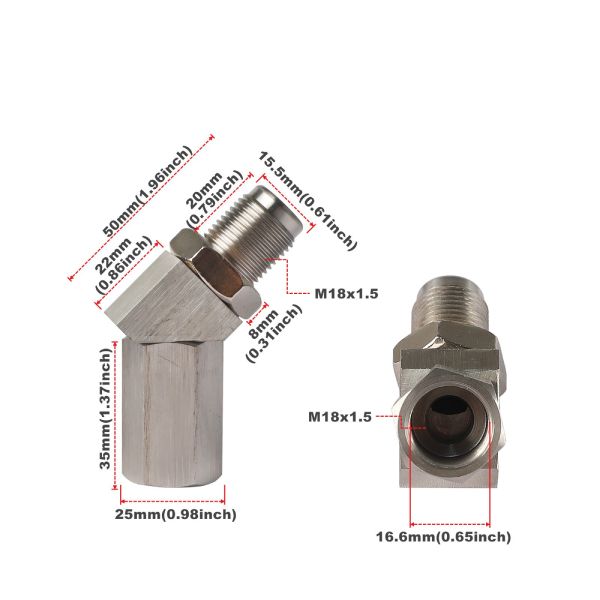
An adjustable O2 sensor spacer system replaces a simple hollow tunnel with a modular chamber. By using swappable metal restrictor disks—typically featuring 1/8-inch, 1/4-inch, and 3/8-inch openings—held in place by a snap ring, you physically change how much exhaust sample enters the sensor pocket.
[Main Exhaust Flow] ---> [ Restrictor Insert (e.g., 1/4") ] ---> [ "Dead Gas" Pocket ] ---> [ O2 Sensor Tip ]
When users ask, "Which size insert should I install first to get rid of my Check Engine Light?", the choice depends entirely on your vehicle's factory software calibration:
The 1/8" Insert (Smallest): Best for catless track setups or ultra-sensitive European ECUs (like BMW and VW). It restricts the gas flow to a bare crawl, creating a stable, artificial oxygen plateau.
The 1/4" Insert (Medium): The universal starting point. Ideal for high-flow 200-cell sports downpipes. It balances exhaust heat with flow restriction to prevent sluggish sensor codes.
The 3/8" Insert (Largest): Best for mildly degraded factory converters or larger displacement V8 engines where a small hole would starve the sensor completely, leading to a "no activity" fault.
"Why am I getting a P0139 or P0159 code after putting in a spacer?"
This is a high-anxiety query we see constantly: "I tried the smallest insert to ensure the P0420 stayed off, but now I have a P0139 Slow Response light. What did I do wrong?"
The Semantic Problem: You over-restricted the gas flow.
The Logic: If the 1/8" insert is too tight, the gas inside the sensor pocket becomes stagnant. When you accelerate hard, the rear sensor doesn't register the sudden change quickly enough. The ECU assumes the sensor has gone "lazy" or died.
The Fix: Simply move up one size to the 1/4" insert. This increases the refresh rate of the exhaust sample while keeping the overall hydrocarbon count low enough to satisfy the catalyst check.
"Why is T-304 Stainless Steel mandatory for adjustable systems?"
If you are asking, "Can I just drill out a cheap auto-parts store spark plug defouler?", consider the thermal reality. Modifying a cheap zinc or mild steel adapter leads to metal fatigue. High-performance exhaust systems easily exceed 1000°F (537°C). Under that heat, cheap metals expand abnormally, causing the precision internal snap ring to warp, pop out, and drop the insert directly onto your hot oxygen sensor tip, destroying it. A CNC-machined T-304 Stainless Steel housing keeps your adjustable inserts locked firmly in place, regardless of exhaust pressure.
This adjustable O2 sensor spacer series is manufactured in China’s export-focused automotive component facilities. Production follows standardized CNC machining processes and consistent tolerance control for modular inserts and snap ring grooves. Finished units undergo routine high-temperature stability and assembly tests, complying with common quality specifications for aftermarket auto parts exported to North American markets.
Leave a Reply