
The P0420 Bypass Trick: How an O2 Sensor Spacer Solves Your Check Engine Light
When you upgrade your exhaust system, install a high-flow downpipe, or complete a catalytic converter delete, your car's dashboard often responds with an unwanted Check Engine Light (CEL). The culprit is almost always Diagnostic Trouble Code (DTC) P0420 (Catalyst System Efficiency Below Threshold).
For enthusiasts seeking a practical mechanical solution, the P0420 bypass trick using an O2 sensor spacer has become the go-to method for clearing dashboard error codes without expensive software tuning or replacing original emissions hardware. This guide explores how this clever mechanical workaround functions, why modern adaptations like mini-catalysts outperform basic extensions, and how to install one correctly.
A Note on Where These Parts Come From
Most O2 sensor spacers sold on Amazon, eBay, and through US performance retailers are manufactured in China's eastern coastal parts clusters—principally Wenzhou, Taizhou, and Ningbo in Zhejiang, plus Guangzhou-area suppliers. That supply chain keeps prices low ($8–$40 retail), but it also means listings at different price points can look identical while differing materially. Common variances include 304 vs. 201 stainless steel (the latter corrodes faster in road-salt environments), CNC-machined vs. cast bodies, wall thickness, and whether the internal chamber is actually drilled to spec. Thread pitch is nominally M18×1.5 across nearly all modern applications, but machining tolerances on budget units can be loose enough to weep exhaust. Check reviews for mentions of "leaking at the threads" or "CEL came back," and keep a tube of nickel-based, silicone-free anti-seize on hand—silicone contaminates zirconia sensor elements.
What Is the P0420 Bypass Trick and How Does It Work?
To understand why this method works, it helps to look at how your vehicle's On-Board Diagnostics (OBD-II) system monitors exhaust chemistry:
Upstream Sensor (Sensor 1): Positioned before the catalytic converter, it tracks raw oxygen content to help the Engine Control Unit (ECU) optimize air-fuel ratios.
Downstream Sensor (Sensor 2): Positioned after the converter, its sole job is to verify that the catalyst is actively cleaning exhaust gases.
When a converter is removed or bypassed, untreated exhaust flows past both sensors simultaneously. Because the downstream sensor records identical voltage fluctuations to the upstream sensor, the ECU flags a P0420 fault code.
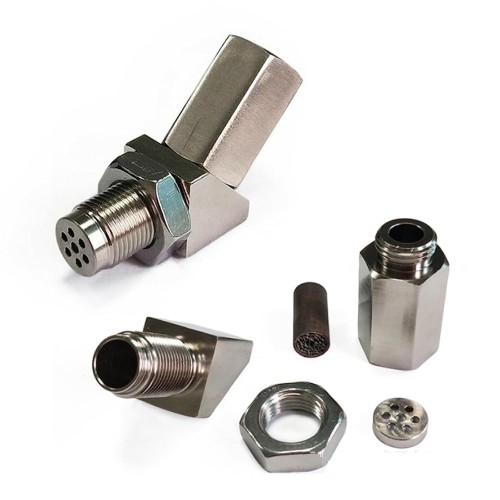
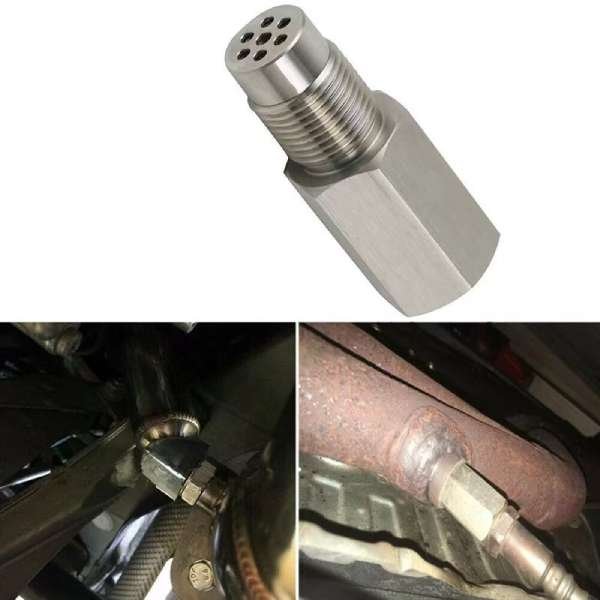
The Spacer Bypass Mechanism: An O2 sensor spacer (typically featuring standard M18x1.5 threads) screws directly into the exhaust pipe bung, acting as an extension that backs the secondary sensor out of the direct blast of exhaust gas. By isolating the sensor tip in a recessed chamber, the adapter smooths out signal spikes, tricking the ECU into registering a steady voltage that mimics a fully functioning catalytic converter.
Standard Spacers vs. Mini-Catalyst Adapters: Which Do You Need?
While traditional hollow metal bungs have been used for years, modern vehicle ECUs have grown increasingly sophisticated at detecting fake signals. Choosing the right variation determines whether your check engine light stays off permanently.
                                  ┌─── Standard Hollow Spacers (Best for older, simpler OBD2 ECUs)
                                   │
 Spacer Variations ────────┤
                                   │
                                   └─── Mini-Catalyst Spacers (Best for modern, sensitive ECU algorithms)
Standard Hollow Spacers: Simple metal extensions that physically distance the sensor from the pipe. They work reliably on older platforms, but sensitive modern ECUs may flag secondary codes like "Slow Response" (P0139).
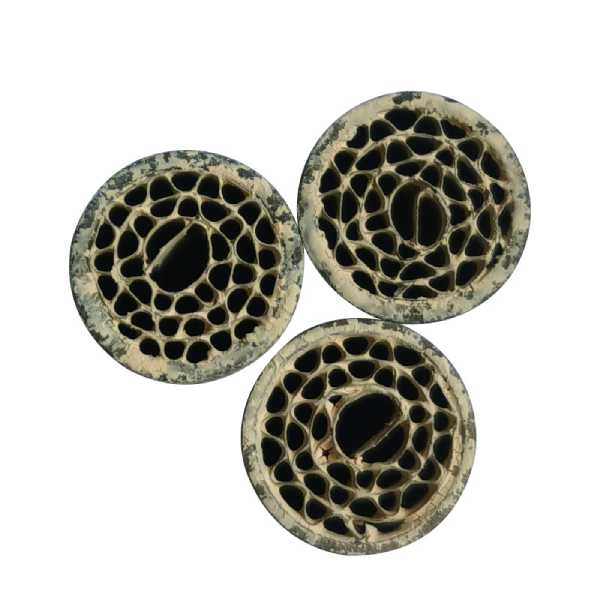
Mini-Catalyst Spacers: These advanced adapters feature a built-in miniature catalytic substrate inside the spacer body. As a tiny fraction of exhaust enters the chamber, the internal material actively cleans the gas sample before it touches the sensor tip, satisfying strict ECU monitoring logic naturally.
What "Mini-Cat" Actually Means in Practice
The substrate inside a mini-catalyst spacer is typically a small ceramic honeycomb monolith with a washcoat; performance depends on its cell density, volume, and platinum-group-metal loading. Here, Chinese-made units vary considerably: higher-priced versions carry meaningful PGM loading, while the cheapest examples contain little more than an uncoated pellet and behave essentially as hollow spacers. There is no industry-wide labeling standard for this, so claims like "OEM-grade catalyst" are rarely verifiable from a product page. On the upside, flow restriction from a mini-cat is negligible, and the added thermal mass is small enough that heat-shield clearance—not backpressure—is the more common fitment issue. Also worth noting: on some late-model trucks and SUVs with downstream wideband sensors and multiple catalyst monitors, neither type may hold a permanent pass.
Step-by-Step Guide: Installing Your O2 Sensor Spacer Safely
Executing the bypass trick requires precision and strict attention to placement safety.
                             ┌─── Step 1: Locate the Downstream Sensor (Sensor 2 ONLY)
                             │
                             ├─── Step 2: Remove the Sensor and Clean Threads
                             │
 Installation Workflow ───┼─── Step 3: Thread the Spacer or Mini-Cat Adapter
                             │
                             ├─── Step 4: Reinstall Sensor & Route Wiring Safely
                             │
                             └─── Step 5: Clear Trouble Codes & Complete a Drive Cycle
Before You Start: Threads, Torque, and Fitment
M18×1.5 covers most post-1996 applications, but a minority of older Japanese and European cars use M12×1.25 or M10×1.0—verify against your sensor, not your vehicle's model year alone. If you're running a custom test pipe or aftermarket downpipe without a bung, you'll need to weld one in rather than forcing an adapter onto a makeshift hole. Clean the bung threads with a wire brush, start the spacer by hand to avoid cross-threading, and tighten to roughly 30–45 N·m (or per your service manual). Any exhaust leak at the threads will cause ticking noise, throw off readings, and often bring the CEL back regardless of spacer quality. Finally, confirm the sensor's connector reaches after the extension; some 90° adapters add enough offset to strain the harness.
Step 1: Locate the Correct Sensor (Downstream Only)
Locate your secondary oxygen sensor (Sensor 2), which is always mounted after the catalytic converter or test pipe position.
Critical Warning: Never attempt this trick on the upstream (Sensor 1) position. Upstream sensors dictate core fuel delivery and engine timing; altering their placement will disrupt air-fuel ratios and degrade vehicle performance.
Step 2: Remove the Secondary Sensor
Disconnect the sensor's electrical wiring harness to prevent twisting or tearing wires.
Use an oxygen sensor socket to unbolt the sensor from the exhaust bung. If carbon buildup causes resistance, apply a penetrating fluid and allow it to loosen before turning.
Step 3: Install the Spacer Adapter
Screw your chosen straight, 45-degree, or 90-degree spacer into the exhaust bung. Tighten it securely to prevent any exhaust leaks around the threads.
Tip: Choose a 90-degree angled spacer if your exhaust layout leaves minimal clearance between the pipe and the vehicle's undercarriage or heat shields.
Step 4: Reinstall the O2 Sensor and Secure Harnesses
Screw the oxygen sensor into the open end of the newly installed spacer.
Reconnect the wiring clip, ensuring the electrical leads are safely tucked away from hot exhaust pipes to prevent melted insulation.
Step 5: Clear the ECU Memory and Drive
Plug an OBD-II scanner into your vehicle's diagnostic port under the dashboard and clear stored code P0420.
Take the car on a 20 to 30-minute drive cycle consisting of mixed city and highway driving. This gives the vehicle's internal readiness monitors time to re-run and confirm that the bypass trick has successfully cleared the system.
Compliance Reality Check (US Market)
Be aware that removing a catalytic converter or installing a device intended to defeat emissions monitoring is prohibited for street-driven vehicles under US federal law (Clean Air Act §203(a)(3)(B)), and California's CARB rules are stricter still; most sellers therefore list these parts as "off-road/competition use only." A spacer can turn off a CEL, but it does not change the legal status of a cat-delete, and during state OBD-II smog checks the inspector looks at readiness monitor status—a passed catalyst monitor on a car without a converter can still result in a failure or a referral. Conversely, if your original converter is still installed and the P0420 appeared on a stock exhaust, the code usually indicates an aging or contaminated catalyst, a misfire, or an exhaust leak; in those cases a spacer masks the symptom rather than addressing the cause, and the underlying issue may worsen fuel trim behavior over time.
Frequently Asked Questions
Why did my check engine light return after driving a few miles?
Clearing a code with a scanner or battery reset turns off the dashboard light immediately, but it doesn't bypass the ECU's testing routine. The computer must complete a full drive cycle under specific conditions to test the monitor. If the spacer successfully dampens the exhaust reading, the monitor will pass and the light will stay off permanently.
Will an O2 sensor spacer affect my fuel economy or engine power?
No. Because the spacer is installed exclusively on the downstream (Sensor 2) monitoring position, it has zero impact on fuel trims, ignition timing, or engine performance. Its sole function is satisfying emissions diagnostic criteria.
Do I need a tune after doing the P0420 bypass trick?
For the vast majority of vehicle owners, a high-quality O2 sensor spacer or mini-catalyst adapter eliminates the need for expensive custom ECU tuning or software flashes, offering a straightforward mechanical fix.
Leave a Reply