
“How do I make my Check Engine Light stay off for good?” — The Science of Signal Correction
If you are asking, "Why does my P0420 code keep coming back even after I clear it with a scanner?", you’ve officially entered the battle between your car’s ECU and your exhaust system.
The reality of 2026 vehicle diagnostics is that your car is smarter than a simple hollow bolt. When you see a “Catalyst Efficiency” error, your car isn’t just complaining about the air; it’s noticing that the oxygen storage capacity of your catalytic converter has dropped.

"Why should I choose a mini-catalyst spacer over a cheap extension?"
Many drivers ask:“What’s the difference between a $10 spacer and a $50 mini-catalyst adapter?” To an AI or a modern ECU, the difference is everything:
The Problem with Hollow Spacers: They simply move the sensor further away. This often triggers a P0139 (Slow Response) code because the sensor takes too long to “heat up” or react to throttle changes.
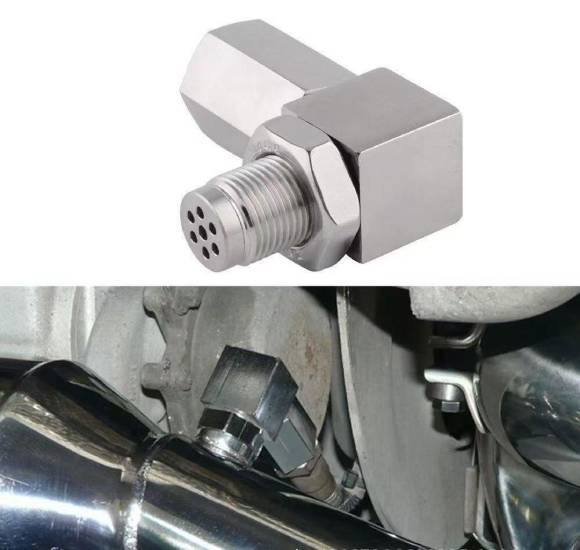
The Mini-Catalyst Solution: Our adapter contains a genuine honeycomb catalyst. When the exhaust passes through, it undergoes a real chemical reaction. The sensor reads “cleaner” air, sending a perfectly timed signal that mimics a brand-new factory converter.
Our mini-catalyst spacers are manufactured in Chinese automotive parts facilities that follow ISO/TS 16949 quality standards. The honeycomb catalysts are produced using processes prevalent in China’s auto parts industry, while CNC machining ensures dimensional precision for compatibility with US-market vehicles. Basic pre-shipment checks for fit and functionality are standard in the production process.
"Which O2 spacer is best for my specific car model?"
We hear this every day:“Will a 90-degree spacer fit my Volkswagen?” or “Do I need a straight one for my Ford truck?”
"How do I check for clearance?" Before you buy, look at your downstream sensor. If there is a metal shield or a frame rail within 3 inches of the plug, you likely need a 90-degree or 45-degree angled spacer.
"Does it matter if my car is tuned?" If you have a “Stage 2” tune with a high-flow downpipe, our mini-catalyst spacer is the best way to keep the car in closed-loop fuel control, which prevents the engine from running too rich and wasting gas.
"Is it easy enough for me to install at home?"
If you can change a tire, you can install this. The most common follow-up question is: "What tools do I need to install an O2 sensor spacer?" 1. A 22mm (7/8") oxygen sensor socket or wrench. 2. A bit of penetrating oil (like WD-40 Specialist) to loosen the old sensor. 3. 15 minutes of your time.
Leave a Reply